The Physics of Value
A Unified Theory of Ethics
We don't have to choose between Science and Morality. Morality is the Applied Science of Survival. Entropy is the inevitable tide. Sentience is the swimmer. Ethics is the stroke we use to keep our heads above water.
The Crisis of Meaning
The modern world is running on corrupted software. We are paralyzed by a false dichotomy:
Materialism
Claims the universe is a machine, so nothing matters.
Moralism
Claims things matter, but appeals to "magic" or "feeling" to prove it.
We are trying to run a 21st-century civilization on Bronze Age operating systems.
The solution is not to choose between Physics and Values. It is to integrate them into a single coherent Stack.
The Zoverions Stack
A unified theory bridging Physics and Values—four layers that build upon each other to create a complete ethical framework.
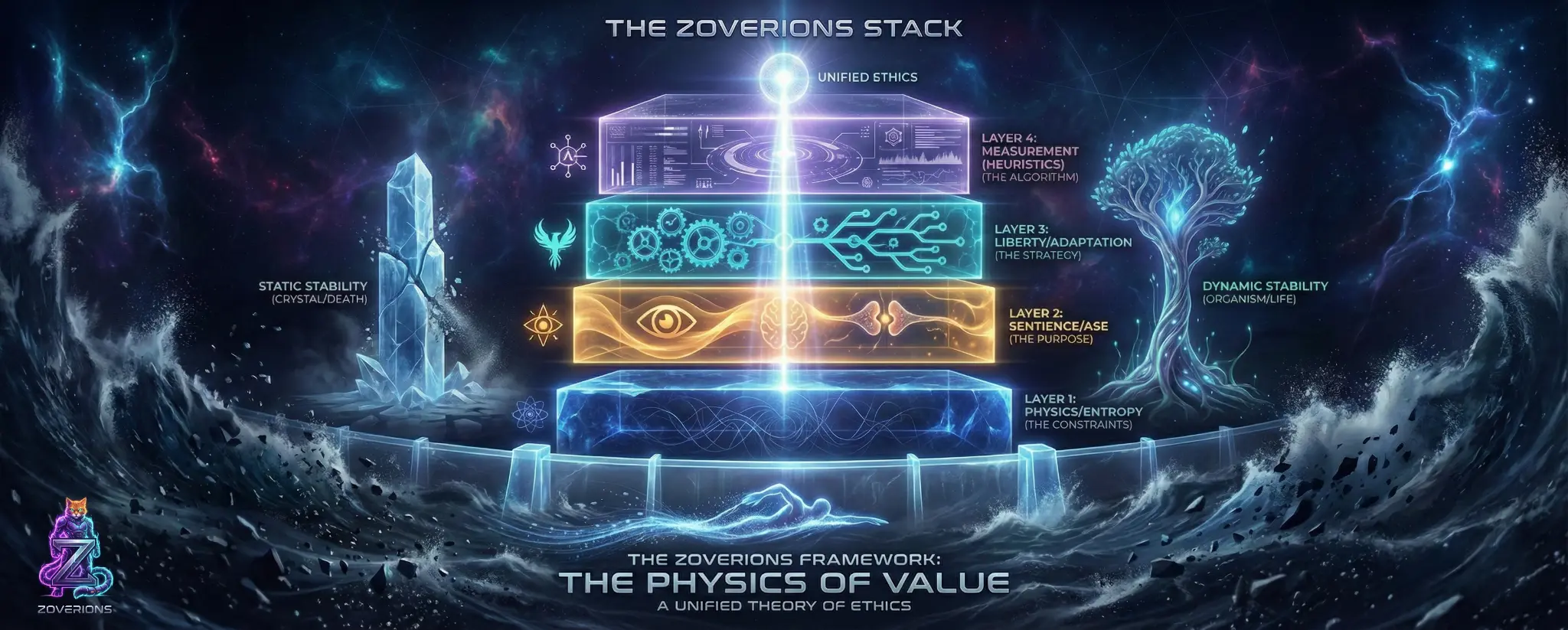
Click the image to view it in full screen
The Four Layers
The Measurement Stack
Operationalizing Ethics: Heuristics derived from Systems Theory to handle uncertainty and calculate trade-offs in real time.
Event Horizon Principle
Time Discounting
Should we burn coal to save a freezing child now, or ban coal to save the climate in 50 years?
Moral Weight = (Magnitude × Probability) / √(Temporal Distance in years)
Rule: Prioritize certain, present suffering over speculative, future suffering—unless the future risk is both catastrophic and highly probable.
Concentrated vs. Diffuse
Certainty Amplification
How do we compare certain small harms vs. uncertain large harms?
Certainty amplifies moral weight disproportionately.
Rule: A 100% probability of harming 1 person carries more weight than a 1% probability of harming 100 people.
Reversibility Heuristic
Preserving Optionality
We don't know which policy will work.
Irreversible Decisions (nuclear war, extinction) → Maximum caution. Reversible Experiments (policy trials) → Acceptable if monitored.
Rule: When uncertain, choose the path that preserves Optionality. Avoid closing doors.
Boundary Hierarchy
Efficiency-Based Prioritization
Do I save my child or a stranger?
Self-Preservation → Local (Family/Community) → Global (Species). Prioritize where you have Maximum Leverage.
Rule: Allocate effort where your marginal impact is greatest. This is Thermodynamic Efficiency, not Tribalism.
The Integration Principle
When measurement heuristics conflict, apply this hierarchy:
Worked Example: Fossil Fuels
The framework gives different answers at different times because the data changed. This is Adaptive Rationality.
1850: Coal Adoption
Entropy Scan:
Massive immediate reduction (heat, power, survival). Future harm unknown.
Event Horizon:
High certainty of immediate benefit vs. zero info on future harm.
Reversibility:
Reversible (can stop mining).
Verdict: Coal adoption was morally justified.
2026: Continued Expansion
Entropy Scan:
Immediate mixed benefit (energy vs. pollution). Catastrophic future entropy (climate collapse).
Event Horizon:
High certainty of future catastrophe (Science is robust).
Alternatives:
Viable substitutes exist (Solar/Nuclear).
Verdict: Continued coal expansion is morally unjustified.
A Note on Limitations
This framework provides directional guidance grounded in physical and phenomenological reality. It does not claim to resolve every edge case with mathematical precision. Reasonable people may disagree on:
- Exact weighting between competing heuristics
- Precise boundaries of sentience (especially for edge cases like insects or future AI)
- Time discount rates for future suffering
These are features, not bugs. A moral framework that claims to answer every question with certainty is selling false precision.
Where uncertainty remains, we default to: Preserve optionality, minimize irreversible harm, and maintain the conditions for future moral learning.
The Final Statement
We don't have to choose between Science and Morality.
Morality is the Applied Science of Survival.
Entropy is the inevitable tide. Sentience is the swimmer. Ethics is the stroke we use to keep our heads above water.
We build the dam not because we are commanded to, but because we understand the physics of the flood.